

Why Do Ophthalmologists Recommend RLE Over LASIK for Certain Patients?

Most people who start researching vision correction land on LASIK first. It’s well-known, widely available, and has a strong track record. But LASIK is a corneal procedure, and not every patient’s vision problem originates in the cornea.
For a significant portion of people, particularly those in their mid-40s and beyond, the right answer isn’t reshaping the surface of the eye. It’s replacing the lens inside it.
Refractive Lens Exchange, or RLE, doesn’t get as much attention as LASIK in everyday conversation, but ophthalmologists recommend it regularly. Keep reading to learn more about RLE and why it can be a great option for many patients.
Why Wouldn’t LASIK Work for Me?
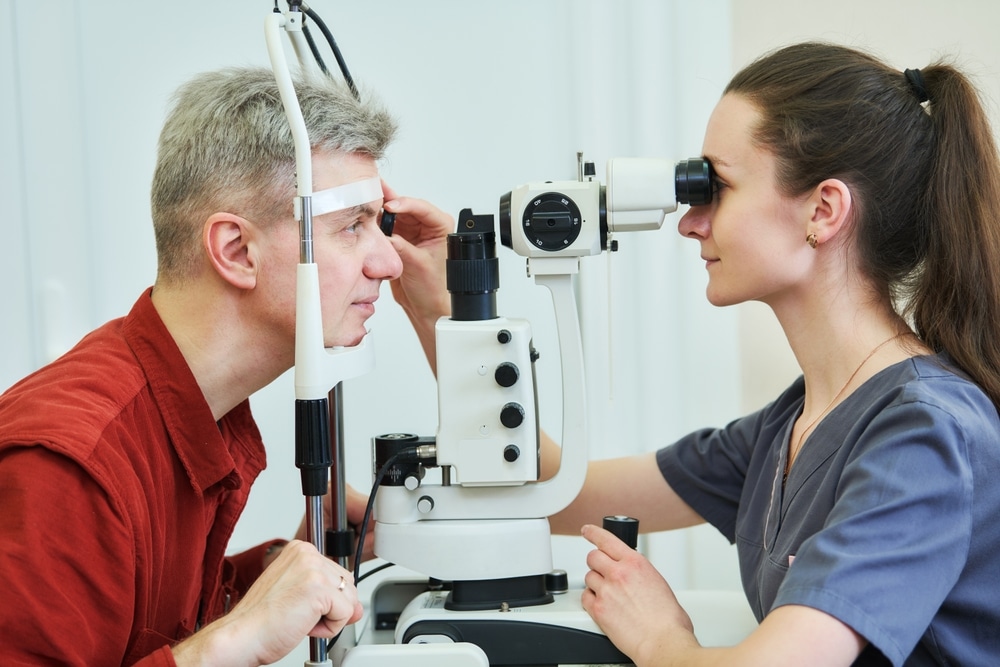
LASIK works by using a laser to reshape the cornea, correcting the way light focuses on the retina.
For that to work safely, a patient needs enough corneal tissue to reshape without compromising the structural integrity of the eye. Patients with thinner-than-average corneas may not have sufficient tissue to achieve the needed correction, which puts them outside the range for the procedure.
LASIK can correct nearsightedness, farsightedness, and astigmatism, but there are outer limits. Patients with very high prescriptions, particularly significant farsightedness, may not achieve the same predictable outcomes that patients with moderate prescriptions enjoy.
There are also reasons you may not be eligible for LASIK that have nothing to do with corneal thickness, including dry eye conditions, certain corneal irregularities, and unstable prescriptions.
Age adds another layer to this. Starting around the mid-40s, the eye’s natural lens begins to stiffen. Vision that was stable for decades starts to shift, and patients who might have been good LASIK candidates at 35 find themselves in a different position at 48. LASIK can correct what the cornea contributes to refractive error, but it can’t address what the lens is doing.
What Is RLE and How Is It Different?
Rather than modifying the cornea, RLE removes the eye’s natural lens and replaces it with an artificial intraocular lens (IOL) customized to the patient’s prescription. The cornea isn’t altered.
This matters because for many patients over 45, the lens itself is the source of the problem. Reshaping the cornea around a lens that is stiffening or has a significant refractive contribution produces a partial solution at best. RLE addresses vision correction at its actual source.
The procedure takes about 15 to 20 minutes per eye, is performed on an outpatient basis, and uses the same foundational technique as modern cataract surgery, with the key difference being that the natural lens is removed proactively rather than after it has clouded.
But I Don’t Have Cataracts, So Why Would I Need Lens Surgery?

This is the most common point of confusion, and it’s a fair one.
Cataract surgery and RLE use the same basic technique, but they serve different purposes. Cataract surgery is performed because the natural lens has become cloudy and is impairing vision. RLE is performed because the natural lens, even if still clear, is causing refractive problems or has lost the flexibility needed for comfortable vision at multiple distances.
That loss of flexibility is presbyopia, the age-related condition that makes reading menus and phone screens increasingly frustrating for people in their 40s and 50s. Presbyopia happens because the lens stiffens over time, reducing its ability to shift focus between near and far distances.
It’s a predictable part of how the eye ages, and it affects virtually everyone eventually. LASIK doesn’t address it. RLE does, by replacing the stiff natural lens with an IOL that can be selected specifically to restore functional vision at the distances that matter most to the patient.
What About My Reading Vision and Will I Still Need Glasses?
The answer depends largely on which type of IOL is chosen, and this is one of the areas where modern RLE has advanced considerably. Monofocal lenses correct vision at a single distance, which typically means patients still need reading glasses for close work. But multifocal and extended depth of focus (EDOF) lenses are designed to provide a range of vision, addressing near, intermediate, and distance simultaneously.
At Mueller Vision, Dr. Mueller works with patients to select the lens that best fits their lifestyle and visual goals. Someone who spends significant time on a computer needs a different solution than someone whose primary concern is distance clarity for driving and outdoor activities.
The evaluation process accounts for these differences. Many RLE patients achieve meaningful independence from glasses across most daily tasks, which is an outcome that LASIK alone cannot reliably deliver for someone whose near vision is already changing.
Is This Actually a Long-Term Solution or Will I Need More Surgery Later?
RLE is about as permanent as vision correction gets. The artificial lens placed during the procedure doesn’t age the way the natural lens does. It won’t stiffen, cloud, or change refractive properties over time. Once in place, it remains stable for the rest of the patient’s life in most cases.
There is also a significant downstream benefit that patients don’t always consider at first. Because RLE removes the natural lens entirely, cataracts can never develop in that eye. The natural lens is what clouds to form a cataract, and once it’s gone, that process is no longer possible. Patients who undergo RLE in their 50s effectively take cataract surgery off their future medical agenda. For someone who was likely heading toward that procedure in their 60s or 70s anyway, choosing RLE proactively means addressing the issue once with a premium lens selected entirely around their vision goals, rather than twice on a more reactive timeline.
How Do I Know Which Procedure Is Actually Right for Me?

It takes a thorough evaluation to know. A patient who walks in assuming they need LASIK may be a better candidate for RLE, and occasionally, the reverse is true. Mueller Vision uses advanced diagnostics to assess corneal thickness, prescription range, lens clarity, and the overall health of the eye before making any recommendation.
Dr. Mueller approaches vision correction as a life-stage decision, with defined pathways that account for where a patient is in their visual life.
For patients in their late 40s and 50s, RLE often emerges as the stronger choice because it solves multiple problems at once and eliminates the need for future intervention. For younger patients who aren’t LASIK candidates due to corneal factors or high prescriptions, EVO ICL may be the more appropriate alternative. The procedures available today cover a wide range of patient profiles, and the goal at each consultation is to find the right fit rather than apply a one-size-fits-all recommendation.
Wondering whether RLE or LASIK is the better fit for your eyes? Schedule an appointment at Mueller Vision in Fort Worth, TX.